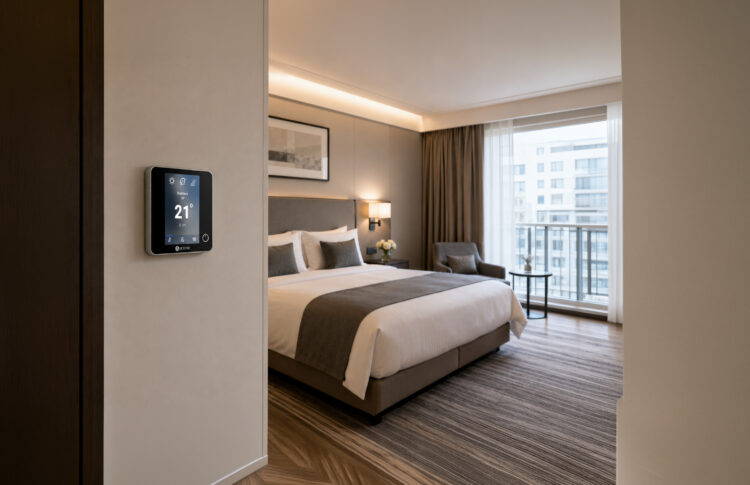
Today, in many hotels, the PMS has a clear picture of the property’s actual occupancy… but the building itself often continues to operate as if all rooms were occupied at all times.
Result:
- heated rooms with no guests present
- an air conditioner left running unnecessarily
- repeated manual adjustments to set temperatures
And yet, all the information is already in your PMS: check-ins, check-outs, reservations, room changes, and upgrades.
So the real question is simple: why doesn’t this information automatically control your heating, air conditioning, and ventilation system?
Behind this topic lies a much broader challenge: finally connecting the building to the realities of hotel operations.
PMS & GTB: What exactly are we talking about?

Before we talk about automation, we need to clarify two key points that are essential to understanding your hotel.
The PMS: The Hotel’s Operational Brain
The PMS (Property Management System) centralizes all hotel management:
- reservations
- room occupancy
- check-in / check-out
- room changes
- customer information
In other words: the PMS is constantly aware of the hotel’s current occupancy status.
Building Management Systems: Technical Control of Buildings
BuildingManagement Systems (BMS) control thebuilding's technical systems:
- heating
- air conditioning
- ventilation
- automated scenarios
- energy regulation
What the connection between the two changes
When the PMS is connected to the building management system (BMS), the PMS provides information, while the BMS acts automatically.
For example:
- a room becomes occupied
- A reservation is canceled
- checkout is completed
- an upgrade is performed
And the building immediately adjusts its operations.
It begins to operate in line with actual conditions.
For hotels that have already connected their PMS to their BMS, the benefits are quickly apparent:
- better control of energy costs
- reduction of technical deviations
- more preventive maintenance
- improved customer experience
- positive impact on customer satisfaction and online reputation
Why the PMS-GTB connection is becoming the foundation of hotel management
Many organizations believe that smart management necessarily relies on:
- artificial intelligence
- complex scenarios
- large-scale technical projects
In reality, the first real step is often much simpler.
Connecting the PMS to the BMS already makes it possible to:
- to automate a large portion of the processes
- to eliminate many manual tasks
- to make immediate gains
Above all, it is often one of the most cost-effective and easiest measures to implement.
Why?
Because the hotel already has the necessary data.
The point, then, is not to generate more information, but to make smart use of the information that already exists.
Specific scenarios that a PMS-GTB connection enables to automate
This is where the PMS-GTB integration really comes into its own, because beyond the theory, it enables the automation of very practical, day-to-day hotel operations.
Check-in: a room is automatically assigned
Before the customer arrives:
- The room automatically returns to the desired temperature
- the heating or air conditioning turns back on
- The amenities are ready when you need them
Result:
- greater comfort upon arrival
- less energy waste
- no manual intervention required
The guest arrives in a comfortable room… without it having been heated unnecessarily all day.

Checkout: automatic switch to eco mode
As soon as a guest leaves their room:
- the temperature drops automatically
- the system switches to economy mode
- unnecessary consumption is reduced
And above all, no more human error.
In many hotels, some rooms remain heated or air-conditioned simply because no action was taken after the guest checked out.
With a PMS-GTB connection, this transition happens automatically.
Smart Management of Unoccupied Rooms
The PMS provides real-time updates:
- that a room is empty
- that a reservation has been canceled
- that an early departure took place
The building management system immediately adjusts the associated scenarios.
Result:
- less unnecessary heating
- less constant air conditioning
- operations that are more in line with the hotel’s actual business
Forecasting Based on Actual Occupancy
One of the key benefits of this connection is the ability to automatically adapt the building to actual occupancy.
A reserved room can:
- automatically return to the correct temperature
- only when necessary
- based on the customer's actual arrival time
Unlike some more rigid systems:
- no rigid logic
- no “theoretical” scenarios
- no automation that is disconnected from the field
Management remains dynamic and adaptable.
And that’s essential in the hospitality industry, where reservations change, arrivals fluctuate, and operations are constantly evolving.

Management of Upgrades and Special Requests
It’s a topic that’s often overlooked… yet it’s very important in the hospitality industry.
Some customers may ask:
- a specific temperature
- a specific setting
- a room change
- a last-minute upgrade
With a platform connected to the PMS, these adjustments can be made immediately.
From the interface, teams can:
- change the instructions
- adjust the operation
- adapt scenarios in real time
Above all, automation never makes the customer experience less flexible.
On the contrary, it allows us to be more responsive and precise.
Why Some PMS Integrations Remain Limited
Not all PMS-GTB connections are created equal.
Some solutions still rely on static forecasts, rigid scenarios, and inflexible logic.
The problem? The reality of a hotel is constantly changing.
In practical terms:
- A reservation may change
- A customer may arrive early
- A room can be changed at the last minute
When scenarios are too rigid, teams have to step in and take control manually.
Conversely, truly effective management must be able to:
- flexible
- dynamic
- remotely adjustable
- capable of responding in real time
The building must adapt to the needs of the business… not the other way around.
The tangible benefits for hotels
Integrating the PMS and BMS yields clear benefits in day-to-day operations.
Reduction in energy consumption
Automation makes it possible to:
- reduce unnecessary heating
- avoid running the air conditioner constantly
- curb hidden abuses
The result: energy consumption that more closely reflects actual occupancy.
Time savings for teams
Without automation, adjustments must be made manually, technical trips are required more frequently, and tasks become repetitive.
With centralized management, your teams have fewer manual tasks to perform because monitoring is simplified, allowing them to respond more quickly.
Improved customer comfort
Comfort becomes more consistent:
- rooms ready upon arrival
- better temperature stability
- a more consistent experience
Find out why your guests notice differences in comfort from one room to another.
Greater visibility for reception and operations
The front desk and operations teams also gain greater visibility:
- quick grasp of situations
- overview of how it works
- greater capacity for action
The result: smoother, more stress-free operations.
Which PMS systems are we compatible with?
Ewattch can integrate with the leading PMS systems used in the hospitality industry to automate the control of technical equipment.
With the option for customized integration based on each institution’s technical environment.
The goal isn’t simply to connect tools; it’s to create a management system that’s truly tailored to how your hotel operates.



PMS + GTB: A sufficient first step toward transforming operations
Many hotels believe that it is necessary to:
- complex projects
- a state-of-the-art building management system
- heavy infrastructure
Before we even get into advanced piloting, you first need to be able to:
- measure
- understand
- adjust the building's operations to match actual occupancy
Find out why simply tracking your usage isn't enough anymore.
Next, you can control the system by connecting your hotel’s PMS and BMS.
This simple automation setup already offers significant performance benefits.
Ultimately, effective automation doesn’t start with complexity.
It starts with measurement, followed by intelligently connecting the right systems.
Connecting the PMS and BMS is not just about automating the heating system.
It’s about connecting the building to the reality of the hotel.
Result:
- fewer losses
- fewer manual steps
- more comfort
- more control
An efficient hotel isn't one that keeps the heat on all the time.
It's a hotel that can automatically adjust its operations based on its actual occupancy.
Does your PMS really control your building?
Check-in, check-out, actual occupancy, upgrades, special requests…
All of this data can become a powerful driver of performance when integrated with your property management system.
Intelligently automating your operations allows you to:
- reduce technical deviations
- save time
- improve the customer experience
- optimize energy consumption
- improve team responsiveness
At Ewattch, we support you through this transformation to make your operations run more smoothly, more efficiently, and with greater peace of mind.