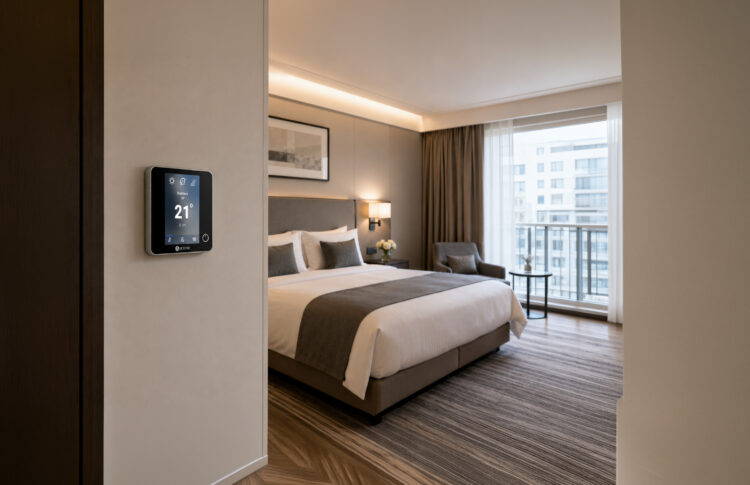
Two guests. Two rooms. Same hotel.
And yet, a different experience.
From a room that’s too hot to one that’s perfectly temperature-controlled, from instant hot water to erratic supply, and from inconsistent air quality… These inconsistencies are common.
And above all, your customers notice them right away.
Why comfort levels can vary from room to room in a hotel
Comfort is often associated with luxury, the quality of amenities, and the level of service.
In reality, comfort depends on simple, fundamental elements:
- the temperature
- hot water
- air quality
- ventilation
And these factors are directly dependent on the technical operation.
The main factors contributing to differences in comfort between rooms
In most hotels, the rooms do not all operate in the same way.
This difference can be attributed to several factors:
Settings
that are not harmonized
- different temperature settings
- manual adjustments
- lack of standardization
A lack of connection
to the occupation
- unoccupied rooms kept in operation
- uncontrolled reheating
- failure to adapt to current practices
Equipment that
drift over time
- incorrectly calibrated thermostats
- unbalanced valves
- poorly maintained systems
The result? Each room reacts differently, with performance varying from one room to another, resulting in inconsistent comfort levels when guests arrive.
Problems that go unnoticed but are immediately felt by customers
These discrepancies have one distinctive feature: they are often invisible from the operational side.
What about the customer? These factors are immediate, affect their stay, and directly influence their overall perception of the experience.
These discrepancies are among the most common invisible irritants.
We discuss this topic in our article “The Invisible Irritants That Undermine the Customer Experience.”
Why do these discrepancies often go unnoticed on the operational side?
In many hotels, problems are only detected after a guest returns, files a complaint, and/or sometimes after a negative review.
In other words: too late.
Without an overall view, it is difficult to compare the rooms and identify any discrepancies.
The direct impact on the customer experience and reviews
A guest doesn't judge your hotel as a whole. They mainly judge the room they stayed in.
And these discrepancies often result in:
- inconsistent opinions
- unstable notes
- an irregular reading
The problem? They end up directly affecting your online reputation, resulting in a less controlled image of your business.
To learn more, check out our article Why a poor rating often hides a technical issue.
An equally significant operational impact for your teams
We are aware that these discrepancies affect customers, but what we tend to overlook is that they also impact operations.
This often results in repeated interventions, manual adjustments, and wasted time for teams.
These situations place a heavy burden on your teams on a daily basis, as a lack of consistency creates an additional operational burden for them.
If you’d like to address this issue, we invite you to read our article, “Why Your Teams Spend Too Much Time Dealing with Avoidable Technical Issues.”
How to ensure consistent comfort in all rooms
The most successful hotels have a clear goal: to ensure a consistent experience for their guests.
To achieve this, they standardize settings, centrally control equipment, and adjust conditions based on the hotel’s actual occupancy.
The result? Fewer discrepancies, fewer service calls, and, above all, greater customer satisfaction.
The Role of Management in Ensuring Hotel Comfort

Behind this topic lies a key question: Do you have a clear vision of what true comfort looks like in your rooms?
More often than not, the answer is no.
Teams rely on theoretical settings, customer feedback, or ad hoc interventions.
But without a comprehensive overview, it's hard to know:
- if all the rooms really do offer the same level of comfort
- even if some drift more than others
- or if the conditions are appropriate for the actual occupancy
Here’s a quick and simple comparison to help you understand.
Without steering
- Each room operates independently
- the settings gradually become misaligned
- discrepancies creep in without being detected
In practical terms, the customer experience is becoming inconsistent, unpredictable, and difficult to manage.
With steering
- actual conditions are monitored continuously
- discrepancies are identified quickly
- the settings are standardized across the institution
The result? Consistent comfort, fewer service calls, and a consistent experience from room to room.
In other words: it’s not the level of equipment that makes the difference, but the ability to manage it over time.
Consistency is becoming the norm in the hospitality industry
In short, the guest doesn’t judge your intentions. They judge how they feel the moment they walk into their room.
The temperature. The hot water. The air quality. The comfort of the amenities.
Simple elements… but crucial ones.
Today, it’s no longer just about providing a good experience.
It’s about providing the same experience to every guest, in every room.
In a world where reviews are everywhere and comparisons are constant:
- A positive experience no longer makes up for a negative one
- A “perfect” room doesn’t make you forget an uncomfortable one.
It's the gaps that cost us.
A high-performing hotel is therefore not one that occasionally provides a good experience.
It is one that maintains control over its actual conditions, minimizes fluctuations, and ensures a consistent level of comfort.
This means that performance is no longer determined by peaks in quality, but by the ability to eliminate variations.
Do your rooms really offer the same level of comfort?
Temperature, hot water, air quality…
As we’ve seen, these factors can vary significantly from one room to another without being detected by visual inspection.
Identifying these discrepancies helps ensure a consistent experience, improve customer satisfaction, and reduce the need for intervention.
Ewattch can help you with this process to ensure a great guest experience at your hotels.