
If 2025 had to be summed up in one word for Ewattch, it would be this: shift.
A shift in positioning. A shift in market perception. A shift from ambition to structure.
This year has not been marked by a simple succession of news items, but by a gradual, consistent and deliberate transformation: Ewattch has evolved from a recognized player in energy monitoring to an orchestrator of intelligent building management.
This summary looks back at the highlights of 2025, but above all at what they tell us: a vision that is taking shape, technology that is aligning with the field, and a trajectory that is firmly rooted in the Smart Building ecosystem.
A tense market, a need for clarity

The context for 2025 is clear.
The commercial building sector is under pressure.
- Regulatory pressure, with the rise of the BACS decree and the proliferation of management obligations.
- Economic pressure, in an environment where energy costs remain volatile and every investment must be justified.
- Operational pressure, finally, for operators and managers faced with heterogeneous buildings, often aging, rarely designed for fine control of usage.
Faced with this reality, one thing became clear: data alone is no longer enough.
Service sector players no longer seek to "see" their consumption. They seek to decide, prioritize, and act.
They expect solutions capable of transforming technical complexity into operational levers.
It is in this context that Ewattch's trajectory has taken on its full meaning.
From measurement to management: a conscious evolution
Since its creation, Ewattch has built on solid expertise: measuring and understanding energy consumption.
This is an essential foundation, but one that has become insufficient in the face of current market expectations.
In 2025, the company clarified its direction.
The goal is no longer just to observe, but to steer intelligently.
This implies:
- to go beyond dashboards,
- to propose approaches for prioritizing actions,
- to enable informed decisions that are aligned with budgetary and regulatory constraints.
This change is not cosmetic. It is structural.
It is based on a strong conviction: energy management must be progressive, pragmatic, and focused on return on investment.
HBS: more than a product, a change in architecture
The launch of our solution HBS (Hybrid Building System) at our private event on October 16 is undoubtedly the highlight of this year.
Not because it is a new product, but because it embodies a new way of thinking about BMS (Building Management System).
Before 2025, control systems were often based on monolithic architectures that were complex to deploy, difficult to upgrade, and rarely suited to existing buildings.
With HBS, Ewattch has taken a different approach: offering a direct response to the limitations observed in the field.
A deliberate hybrid approach
Based on SynapseCore, HBS introduces a hybrid approach to energy management that combines:
- local intelligence closely aligned with usage patterns,
- centralized supervision for a comprehensive overview,
- interoperability with existing systems.
In concrete terms, this means:
- the ability to integrate into existing buildings,
- a gradual rollout, building by building, use by use,
- an adaptation to the real priorities of operators.
It breaks with the "all or nothing" logic that has long held back GTB projects.
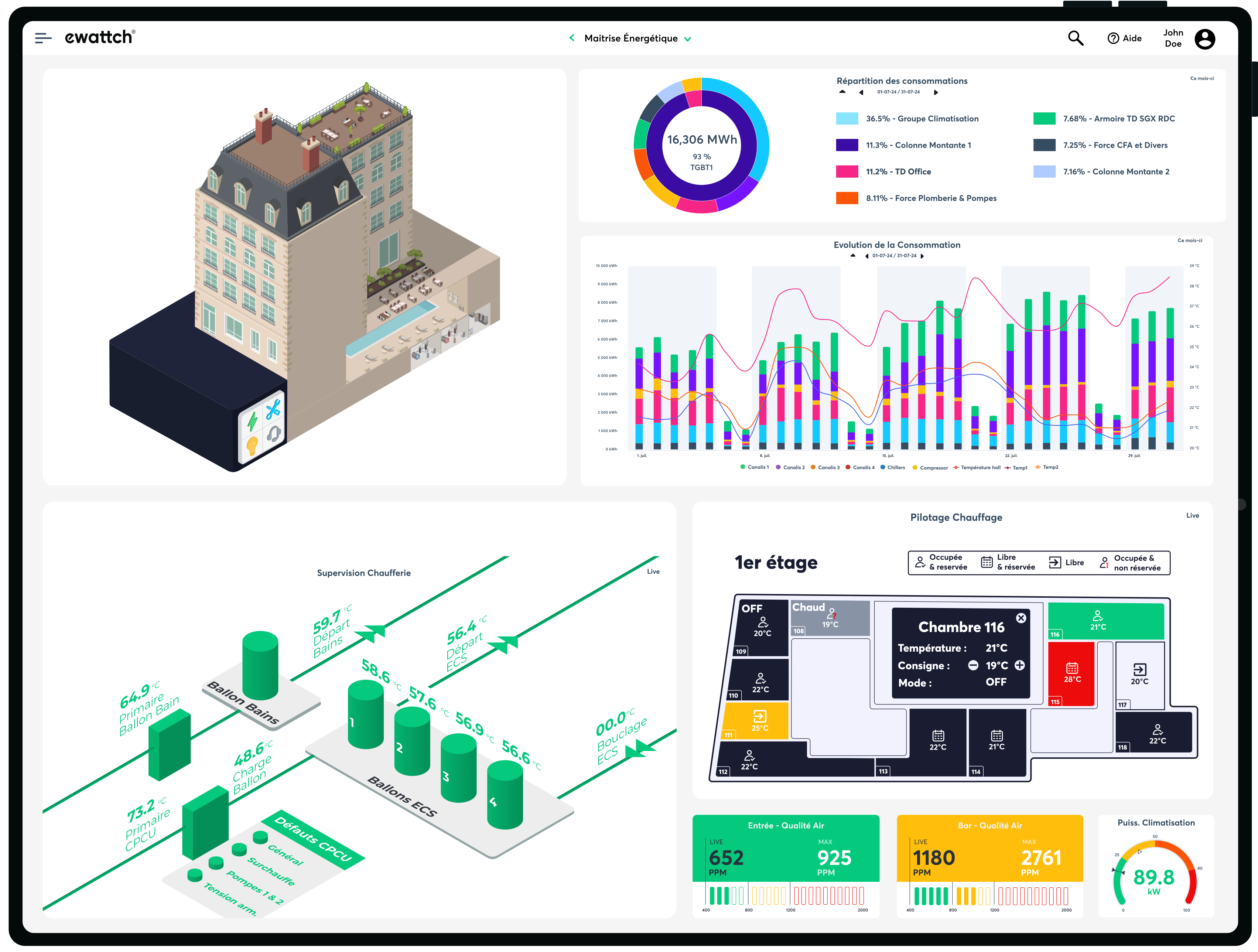
What HBS has actually changed
In practice, this has resulted in very concrete developments:
- projects that are quicker to launch,
- better controlled investments,
- the ability to prioritize actions with a high energy impact.
HBS was not conceived as a theoretical solution, but rather as a technological response to the real-world constraints observed in operations.
Ewattch has therefore made a clear choice: technology that supports operations, not the other way around.
A concrete response to regulatory challenges
2025 was also a year of strong statements on regulatory issues.
The BACS decree, in particular, has raised many questions: timing, costs, feasibility, return on investment.
Rather than adopting an alarmist or purely prescriptive stance, Ewattch has advocated a pragmatic approach:
Regulatory compliance is a goal, but it must be part of an economically sustainable trajectory.
This vision is based on several key principles:
- prioritize high-impact actions,
- focus primarily on buildings where the ROI is the fastest,
- support farmers over the long term.
This position has been widely echoed in the trade media and among decision-makers in the sector, as it reflects a widely shared reality: not all buildings can be treated in the same way, at the same pace.
A year punctuated by fieldwork
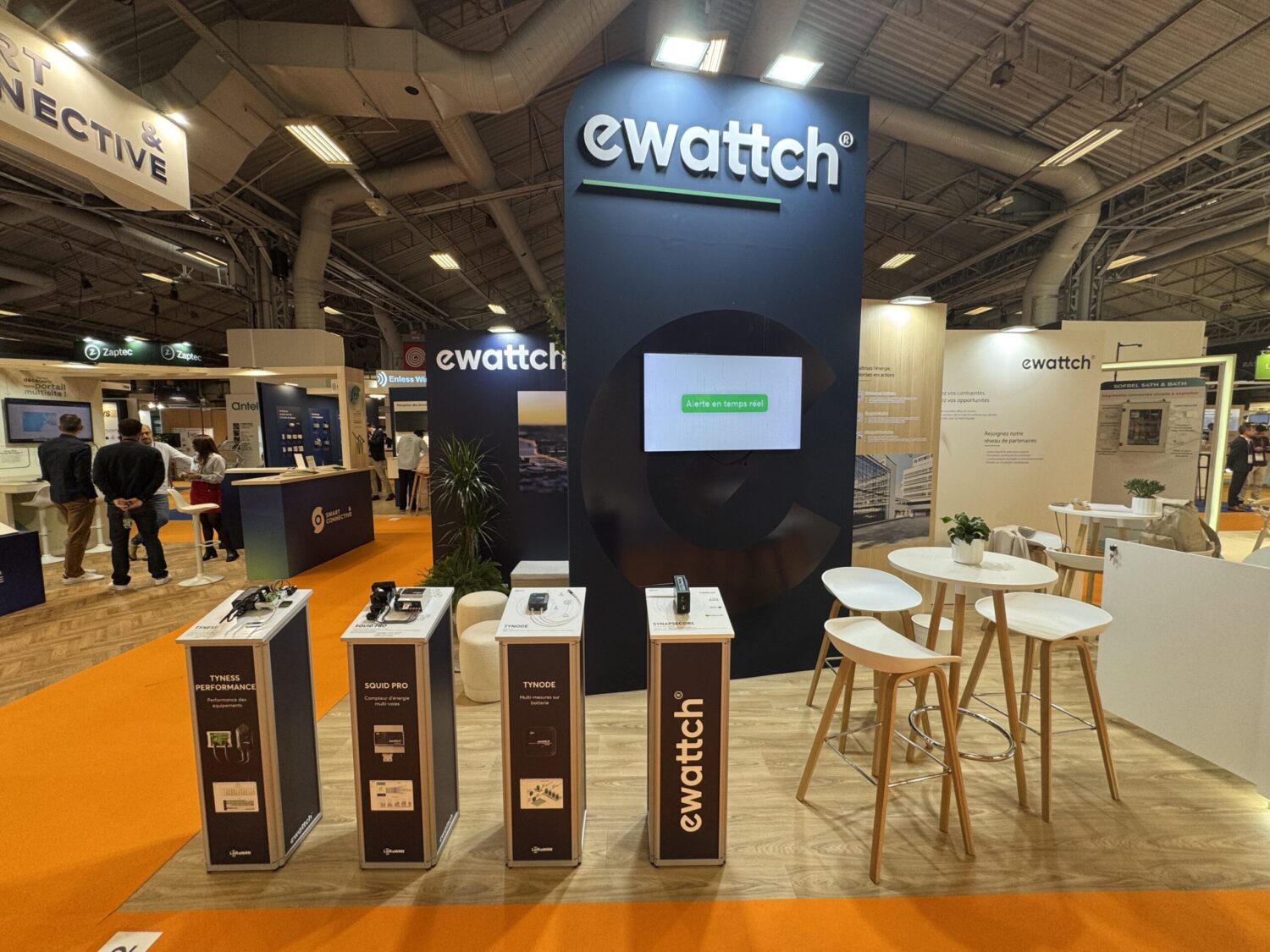
If 2025 marked a strategic shift, it was also because Ewattch constantly tested its choices in the field. Trade shows (CES, IoT World Congress, IBS, UMIH Congress, SIMI, etc.), events, and discussions with executives, operators, technical managers, and asset managers punctuated our entire year.
These interactions highlighted recurring findings:
- heterogeneous buildings,
- partially operated systems,
- a strong expectation for simple, easy-to-use solutions,
- increasing pressure on budgets and teams.
It was based on this feedback that decisions were made. The field did not serve to illustrate our strategy. It built it.
A word that is becoming part of the ecosystem
In 2025, Ewattch has not only developed its solutions. The company has also strengthened its voice.
Indeed, the media and trade press have relayed Ewattch's vision on:
- the future of energy management,
- the limitations of traditional approaches to building management systems,
- the actual conditions for implementing the BACS decree.
Interviews, analyses, regulatory reports: Ewattch has established itself as a credible voice in what is often a complex debate.
A growing company, a vision that is taking shape

Behind the products and advertisements, 2025 also tells a human story.
A growing company with around thirty employees, which is structuring its teams, strengthening its expertise, and asserting its identity.
Ewattch did not seek to position itself as just another "startup."
It took a different stance: that of an orchestrator of French commercial real estate, committed to the long term alongside its employees.
2025 as a foundation for the future
At the end of this pivotal year, Ewattch has laid solid foundations.
A clarified vision. A structured offering. A confident stance.
2025 did not mark an arrival, but a point of equilibrium. From this point onwards, it becomes possible to accelerate the energy transition without losing touch with the reality on the ground.
The next step is a continuation of this approach: making energy management a tool for decision-making, performance, and sustainability that is accessible and adapted to the realities of existing buildings.
HBS, regulation, field. Three pillars. One year.
And a trajectory that is now clearly defined.