
Multi-technical maintenance is no longer just an expense item. It has become a strategic lever for the performance of commercial buildings.
However, in many organizations, the dominant model is still largely reactive.
Between 2021 and 2024, energy costs rose by more than 30%, directly impacting operating budgets. At the same time, client expectations are changing rapidly: measurable energy performance, operational continuity, regulatory compliance, and transparency of results.
In this context, every unexpected breakdown, every consumption deviation, and every emergency intervention becomes an economic and operational risk factor.
Despite this, the reality on the ground remains stubborn: nearly 40% of multi-technical maintenance interventions are still carried out on a corrective basis. This approach has historically been deeply rooted in the profession, but is becoming increasingly difficult to sustain in the face of current challenges.
In addition to this economic pressure, there is also significant regulatory pressure. The BACS Decree gradually mandates the implementation of energy management and monitoring systems between 2025 and 2030, while the Tertiary Sector Decree sets a clear target: a 40% reduction in energy consumption by 2030.
These texts profoundly transform the role of multi-technical maintenance. It is no longer just a matter of intervening, but of measuring, managing, and guaranteeing performance.
In this context, one question arises: can the curative model still be the norm?
For more and more stakeholders, the answer is clear: no.
The transition to preventive maintenance then becomes a strategic imperative.
Corrective maintenance: a model that has run its course

Increasingly costly interventions
Corrective maintenance always comes at the wrong time: when the equipment is already faulty, comfort is compromised, or operations are impacted.
Depending on the type of assets and equipment, corrective maintenance costs between 2 and 5 times more than preventive maintenance. This difference is not solely due to the cost of the repair itself, but also to all the associated indirect costs:
- emergency travel;
- unplanned mobilization of teams;
- premature replacement of components;
- disruption of schedules;
- sometimes even partial cessation of activity.
HVAC equipment accounts for nearly 60% of emergency interventions in multi-site environments. These systems are also the most energy-intensive and critical to occupant comfort.
For example: A heating or air conditioning failure quickly goes beyond the technical scope to become an operational problem, or even an image problem.
In a predominantly curative model, teams are constantly reacting.
Priorities change, schedules become tighter, and service quality becomes more difficult to maintain.
Economic pressure weakening maintenance providers
Economic pressure is now omnipresent in multi-technical maintenance, and it continues to intensify.
Tenders are increasingly being decided on price, particularly for multi-site contracts. The result? Compressed margins, sometimes as soon as the contract is signed.
In this context, even the slightest operational deviation has a significant impact on actual profitability.
The curative model accentuates this fragility. Every unexpected breakdown triggers a chain of costs that are difficult to control: emergency travel, overtime, disrupted schedules, technicians called in at the last minute. These costs are rarely passed on to customers, often absorbed... and they eat into margins, intervention after intervention.
Added to this are rising costs. Pressure to recruit technicians, the need for increasingly specialized skills, and rising operating costs: "doing more with less" is becoming the norm. In a reactive model, this pressure falls directly on the teams in the field.
Another major difficulty is that the value of the work performed remains invisible. As long as everything is working, the maintenance provider's actions take a back seat. The service is taken for granted. Under these conditions, it is difficult to defend the value of the contract when it comes up for renewal or to justify a premium positioning to your customers.
The curative approach thus confines maintenance to a defensive mindset. There is little visibility, few shared indicators, and few levers for differentiation. Re-competition becomes systematic, and discussions focus primarily on price. In this model, maintenance becomes a cost center for both the end customer and the service provider itself.
Maintenance technicians therefore become interchangeable, chosen for their ability to respond quickly and at low cost, rarely for their ability to prevent breakdowns.
Regulatory risk has become a key issue
In addition to these economic constraints, there is now an unavoidable challenge: regulatory compliance.
By 2030, 80% of commercial buildings larger than 1,000 m² must comply with the BACS Decree.
Compliance cannot be based solely on self-declaration; it must be supported by measured, recorded, and auditable data.
Without continuous supervision, it becomes impossible to:
- detect operational deviations;
- operate equipment efficiently;
- produce reliable reports in the event of an audit.
Customers now expect multi-technical maintenance providers to guarantee the energy performance of buildings, not just repair equipment.
Preventive maintenance: a new standard
Shifting from a "firefighter" to a "doctor" role in building management
The difference between corrective maintenance and preventive maintenance is not just a change in scheduling. It reflects a change in business approach.
In a curative model, the maintenance technician acts like a firefighter. They intervene in an emergency, often under pressure, to restore a situation that has already deteriorated. The objective is clear: to get things back up and running as quickly as possible. However, this approach mobilizes a lot of resources for short-term value creation.
It is costly, unpredictable, and difficult to monetize.
In practice, this logic translates into a daily routine largely dictated by urgency. In predominantly reactive organizations, up to 60% of maintenance teams' time is spent managing unplanned incidents. This time is rarely optimized, leaving little room for anticipation, analysis, or continuous improvement.
This approach traps maintenance personnel in a constant reactive mode. Priorities shift as breakdowns occur, teams lack visibility into the overall condition of facilities, and corrective actions follow one after another without always addressing the root causes of problems.
Conversely, preventive maintenance introduces a clear break in the business approach. The maintenance technician becomes a building doctor. Their role is no longer limited to repairs, but consists of monitoring, analyzing, and preventing.
This approach is based on continuous indicators: energy consumption, temperatures, HVAC equipment operation, DHW status, technical alarms, etc. These signals provide a better understanding of the building's actual behavior and enable deviations to be identified before they become visible.
The daily routine of the teams gradually changes. Interventions are no longer triggered solely by emergencies, but guided by analysis and understanding of the facilities. Maintenance thus gains visibility, control, and decision-making capacity.
This change in approach also transforms the relationship with the customer. Dialogue is no longer limited to breakdowns, but extends to equipment reliability, operational continuity, and overall building performance. Maintenance moves away from a reactive approach to a structured and managed support system.
It is this change in approach that then paves the way for measurable gains across the entire chain, both operationally and economically.
Measurable gains across the entire chain
Preventive maintenance is essential because it generates concrete, visible, and measurable results.
Organizations that switch to a preventive model see on average:
- a 30 to 50% reduction in emergency interventions,
- a 20 to 40% increase in equipment lifespan,
- a reduction in overall operating costs of 15 to 25%.
These gains are not the result of a simple decline in activity, but rather a change in approach. By continuously monitoring critical equipment, deviations are detected earlier, before they turn into major breakdowns. Interventions become more targeted, better prepared, and better planned.
Maintenance thus moves away from a reactive approach to a proactive one. Resources are mobilized at the right time, on the right equipment, with greater visibility on actual priorities. This more detailed planning also reduces unnecessary interventions and premature replacements.
But beyond the figures, preventive maintenance provides greater visibility into the actual condition of facilities, which facilitates decision-making and prioritization of actions, as well as dialogue between field teams, technical managers, and decision-makers . Multi-technical maintenance thus gains in clarity, credibility, and ability to demonstrate the value created over time.
A direct response to the challenges faced by maintenance professionals
For executives and agency managers, preventive maintenance is becoming a strategic lever: protecting margins, creating differentiated offerings, and securing long-term contracts.
For technical managers, it provides better control of the fleet, more precise management of equipment, and automated reports that demonstrate performance to customers or management.
For technicians, preventive maintenance reduces the pressure associated with constant emergencies. Interventions become more planned, more targeted, and rely on reliable, easy-to-use tools.
The foundations of truly effective maintenance
Continuous data as a central pillar
There is no effective preventive maintenance without continuous and reliable data.
To anticipate, optimize, and prove performance, multi-technical maintenance professionals need real-time visibility into all critical aspects of the building: energy consumption, temperature and comfort, air quality, domestic hot water, technical alarms, and HVAC equipment.
Data then becomes a decision-making tool, rather than a simple indicator consulted after the fact.
A unified platform to turn data into action
One of the major obstacles to the transition to preventive care is the fragmentation of tools. Scattered data, multiple interfaces, diluted responsibilities: all of these hinder efficiency.
The trend toward smart buildings is clear: unifying platforms and breaking down silos.
A centralized platform brings together monitoring, scenarios, control, reporting, and regulatory compliance in a single, readable, and usable environment. Data is no longer simply collected; it becomes actionable.
Simplicity as a condition for adoption in the field
A preventive maintenance solution is only valuable if it is actually used by field teams.
Wireless technologies, rapid deployment, intuitive interfaces, visual scenarios, interoperability with existing equipment: ease of use is a key factor for success.
It is this factor that determines adoption, the development of team skills, and the ability to deploy preventive measures on a large scale.
Smart maintenance: the culmination of preventive maintenance
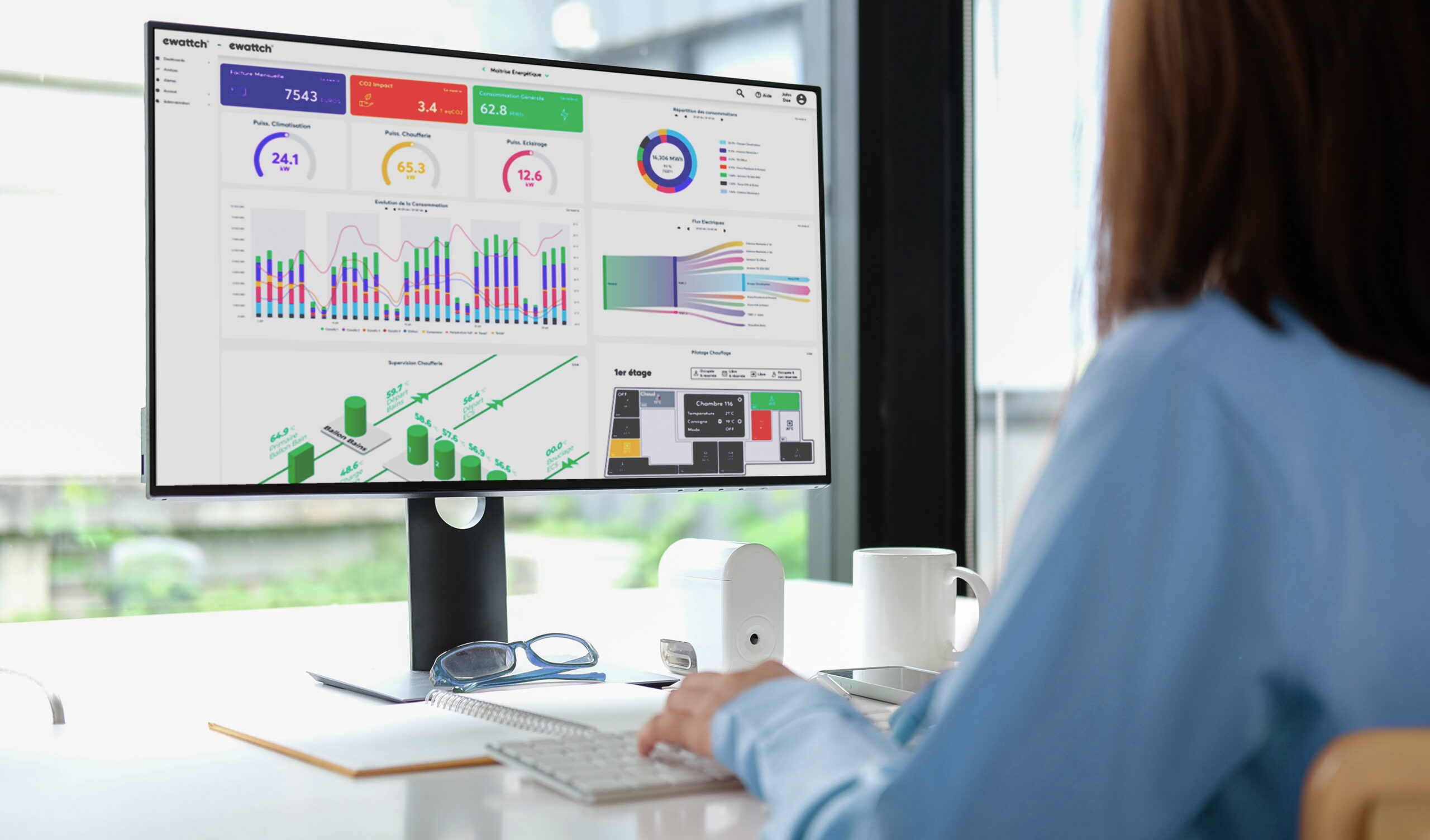
Smart maintenance takes preventive logic one step further. It no longer just monitors and alerts, it acts.
Thanks to continuous monitoring, critical failures can be reduced by 20 to 30%, and consumption deviations are detected several days before they become visible incidents.
- Inhot water systems, monitoring reduces health risks and system failures.
- On the HVAC system, anomalies are identified before equipment shutdown.
- Intelligent control systems can generate energy savings of 20 to 30%, while improving occupant comfort.
Maintenance no longer suffers the building. It drives it.
Ewattch, smart building orchestrator
Moving from corrective to preventive maintenance is not simply a matter of deploying a new tool. Above all, it requires the ability to connect all of a building's equipment, centralize information, and transform it into concrete actions. This is precisely the role that Ewattch, as a true orchestrator of smart buildings, has chosen to play.
Our approach is specifically designed for the realities of multi-technical maintenance, particularly for existing, multi-equipped, and heterogeneous buildings.
The goal is not to replace existing installations, but to connect them, enable them to communicate with each other, and control them intelligently.
Ewattch offers an integrated end-to-end approach, the HBS (Hybrid Building System) :
sensors and actuators → gateways and controllers → cloud platform → scenarios and schedule-based control → reporting and alerts.
This complete control over the chain not only enables data to be produced, but above all guarantees an operational result that can be directly used by field teams and technical managers.
Beyond technology, Ewattch also supports maintenance companies in structuring effective preventive maintenance offerings tailored to operational constraints and end-customer expectations through our partner program. By orchestrating technologies, data, and services, we enable you to transition from a reactive model to a performance-oriented model without excessive complexity.
A real driver of sustainable performance
The future of multitechnique maintenance is preventative, intelligent, and data-driven.
Actors capable of anticipating, managing, and proving performance will become indispensable to their customers. Thanks to an end-to-end approach, solutions such as Ewattch make this transformation accessible, progressive, and profitable.
Multitechnical maintenance is no longer just a service-oriented profession.
It is now becoming a performance-oriented profession.
What if you could actually manage the performance of your contracts?
Energy, comfort, operational continuity, regulatory compliance, equipment reliability...
Do your current indicators really enable you to manage the performance of your multi-technical maintenance contracts?
With Ewattch, discover a performance-oriented approach that harmonizes technologies, data, and services to support the transition to preventive maintenance in a sustainable way.