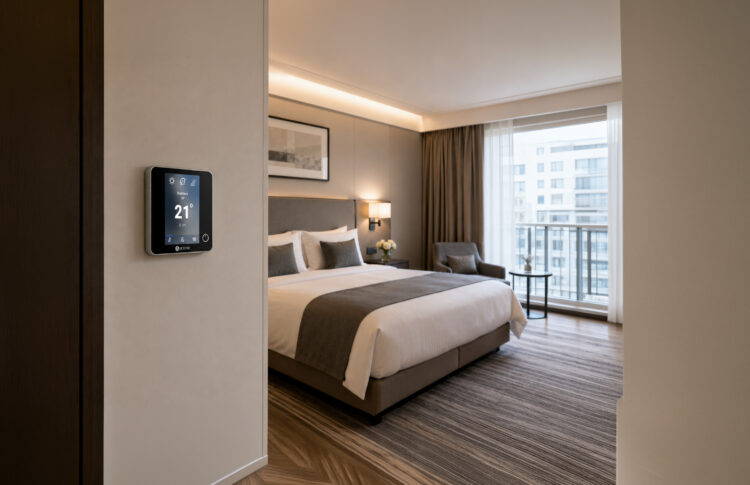
Sometimes, it only takes one small detail to ruin a vacation. A room that's too hot when you arrive. A slight noise from the ventilation system at night. A shower that takes too long to heat up after a long journey.
These details may seem minor. Yet they are the ones that guests remember. Comfort is not just a “bonus” in the hotel experience: it is the invisible foundation upon which overall satisfaction, loyalty… and the establishment’s reputation rest.
For a long time, comfort was approached from a primarily aesthetic perspective: bedding, decor, premium services. Today, it is embodied in more technical but equally decisive dimensions: stable temperature, air quality, soundproofing, lighting, and immediate availability of hot water. In other words, the physical experience of the guest as soon as they enter the room.
The figures confirm this trend:
- 81% of travelers consider thermal comfort to be the most important criterion in a hotel room (Booking.com, 2024).
- Nine out of 10 guests say that physical discomfort affects their overall experience and their loyalty to the property (Accor Data Lab, 2023).
In an industry where the average rating on booking platforms directly affects occupancy rates, RevPAR, and brand image, comfort has become a true indicator of hotel performance.
The question is therefore no longer whether to invest in customer comfort, but rather how to guarantee a consistent, measurable, and sustainable experience while dealing with increasingly stringent technical, energy, regulatory, and economic constraints.
New standards of comfort in the hotel industry

Overall comfort: much more than just bedding and design
Hotel comfort has changed dramatically. Today, it is no longer limited to good bedding or stylish design. Customer expectations have broadened and become more refined, driven by their experiences in other establishments... but also in their own homes, which are increasingly connected and automated.
Today, comfort depends on a controlled indoor microclimate, which combines several parameters:
- a stable temperature, without sudden variations;
- impeccable air quality, with controlled CO₂ levels;
- an appropriate humidity level, avoiding air that is too dry or too humid;
- a quiet environment, without excessive airflow or noisy equipment;
- light that is neither too bright nor too dim, adjusted to suit the time of day.
These elements are rarely explicitly highlighted in hotel communications. Yet they are what determine the feeling of immediate well-being... or latent discomfort.
Hyper-personalization: comfort as a tailor-made service
Another major development: comfort is becoming customizable. Customers no longer accept a standardized experience. They expect a room that adapts to them, not the other way around.
In the most advanced establishments, comfort begins to adjust according to arrival time, season, type of room booked, and even customer profile (habits, preferences, history of stays).
The integration of the building's technical systems with the PMS (Property Management System) paves the way for a new approach: a room prepared before the guest even arrives, at the right temperature, with proper ventilation, and without unnecessary energy consumption.
For a hotel manager, this means a smoother experience, fewer complaints, and an upgrade.
Discreet, quiet, and invisible equipment
Today, we are faced with a paradox: the more prevalent technology is, the less visible it should be.
Customers don't want to "feel" the technology. They simply want everything to work naturally. Equipment must be quiet, discreet, automatic, and perfectly integrated into the existing environment.
This is precisely where new generations of technical solutions, particularly wireless ones, come into their own. They enable building management to be modernized without major construction work, without interrupting operations, and without compromising the customer experience.
This approach is particularly strategic forthe hotel industry, where every unavailable night represents a direct loss of revenue.
Sustainable comfort: an expectation that has become essential
Finally, comfort can no longer be separated from the establishment's environmental approach.
Travelers are increasingly aware of the environmental impact of their trips, but with one clear requirement: no compromise on their own well-being.
According to the Booking Sustainable Travel Report 2024 :
, 74% of guests say they are more likely to choose a hotel committed to environmental sustainability, provided that it does not compromise their comfort.
For CSR departments and senior management alike, the challenge is therefore twofold:
- reduce the hotel's energy footprint;
- while ensuring, or even improving, the comfort experienced by customers.
It is this new balance of “comfort and sustainability” that is redefining the standards of the modern hotel industry.
Concrete levers to guarantee customer comfort
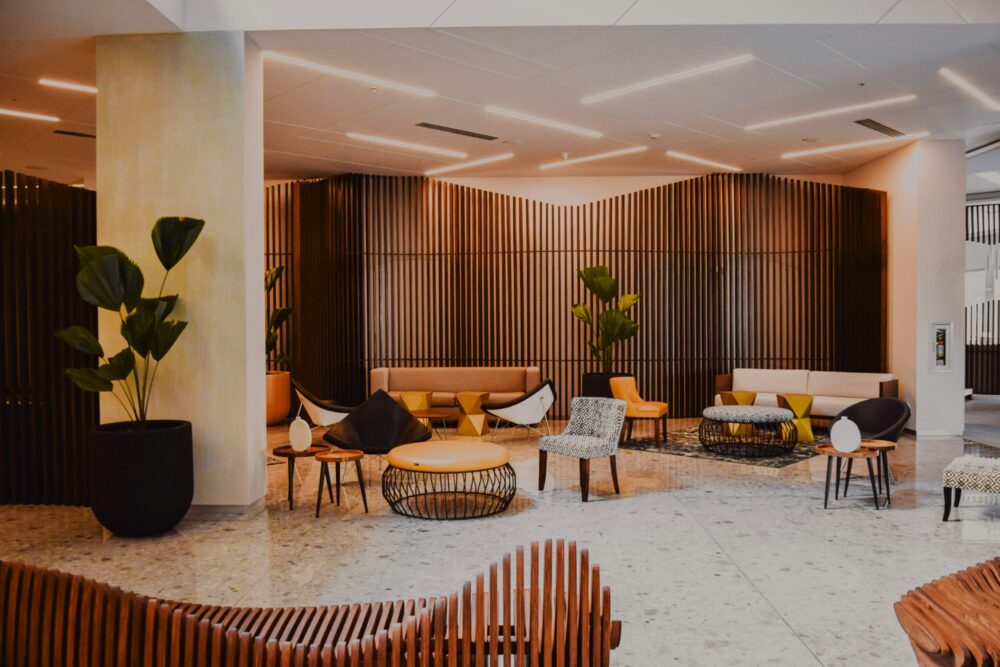
Controlling temperature and hot water: the basis of the customer experience
Temperature and hot water remain the primary factors for satisfaction... or dissatisfaction in a hotel.
A room that is too hot or too cold, poorly adjusted air conditioning, lukewarm water when showering: these situations almost always lead to complaints, negative reviews, and damage to the brand image.
Ensuring comfort requires precise and dynamic management of temperature, air conditioning, and domestic hot water (DHW).
The most successful establishments now rely on building management systems (BMS) capable of anticipating usage based on the actual occupancy of rooms and common areas.
The result? A temperature stabilized around the ideal setting, immediate availability of hot water, without unnecessary overheating or energy waste.
Ensuring air quality: invisible but crucial comfort
Indoor air quality has long been a secondary concern in the hotel industry. Today, it is becoming a major factor in customer well-being and satisfaction.
Stale air with high CO₂ levels directly impacts sleep quality, feelings of fatigue, and the overall experience of the stay, even if the guest does not always identify the cause.
To avoid this, modern solutions now enable continuous monitoring of CO₂ and humidity, with ventilation automatically adjusted according to the actual occupancy of rooms and common areas. The impact then becomes measurable.
According to Hospitality Insights 2023, establishments with a controlledIAQ (Indoor Air Quality)score see an average 12% increase in their overall rating on booking platforms.
For a CEO or CSR director, this sends a strong message: air quality is becoming a differentiating factor, just like design or services.
Preventive maintenance: the invisible pillar of comfort
Customer comfort is not just about the moment of arrival. It depends on the continuous reliability of the equipment.
A hot water tank failure, a temperature drift, faulty ventilation: these incidents are often preceded by subtle signs... but you still need to be able to detect them in time.
Advanced monitoring solutions, such as Ewattch's HBS (Hybrid Building System), enable:
- identify deviations before they become visible to the customer;
- alert the technical teams in advance;
- to intervene without urgency, without stress, without impacting operations.
These solutions offer numerous benefits:
- a smooth and seamless customer experience;
- fewer technical emergencies;
- better organization of teams;
- and a significant reduction in corrective maintenance costs.
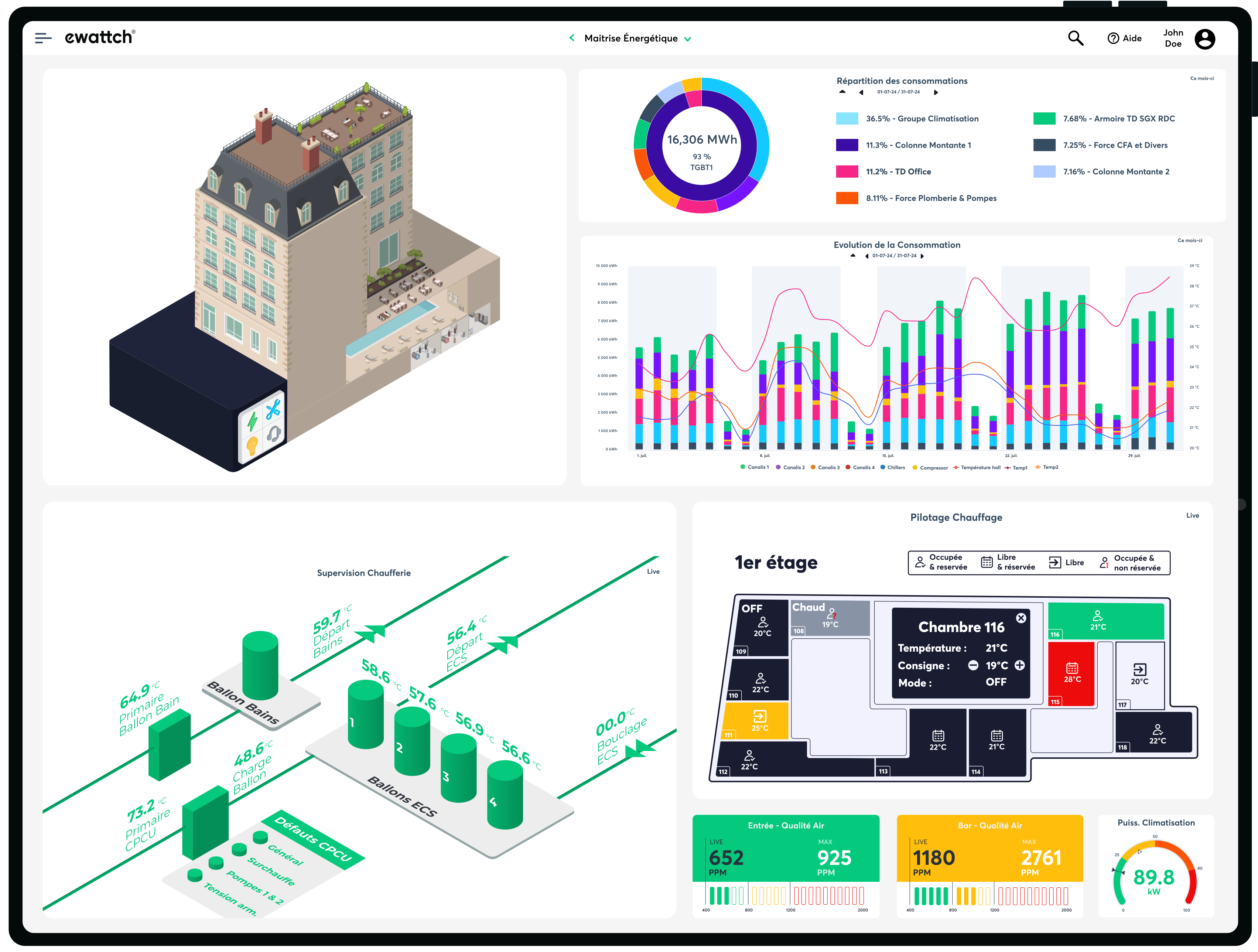
Measurable comfort: data as a new strategic asset
For a long time, customer comfort was perceived as a subjective concept.
Today, it has become measurable, controllable, and objectifiable.
Building management systems transform feelings ("It was too hot") into concrete indicators that can be used by management:
- temps moyen pour obtenir de l’eau chaude (objectif : < 15 secondes) ;
- thermal stability (maximum deviation ± 0.5°C);
- qualité de l’air (CO₂ < 900 ppm) ;
- rate of anomalies detected before customer complaints.
This data feeds into operational dashboards, which are useful on several levels: continuous improvement of service quality; management of technical teams; promotion of the CSR approach to customers, partners, and investors.
The result? Customer comfort becomes a performance indicator as concrete as RevPAR.
The modern equation: comfort + energy efficiency

Contrary to popular belief, ensuring customer comfort is no longer incompatible with energy efficiency.
Thanks to hybrid, scalable, and modular building management system solutions, such as the one we offer, it is now possible to:
- regulate each room individually;
- connect the control system to the PMS data;
- avoid heating or air conditioning unoccupied rooms;
- reduce energy consumption by up to 25% without compromising comfort.
This approach also meets regulatory requirements, particularly those of the BACS & Tertiaire Decrees, which encourage automation, supervision, and preventive management of technical equipment.
For senior management and CSR departments, this is a strategic lever: making compliance and energy performance a driver of comfort and value, rather than a constraint.
From perceived comfort to controlled comfort
Customer comfort is no longer a secondary issue. It has become a key factor in differentiation, profitability, and reputation for hotels.
Modern establishments no longer simply promise an impeccable experience. They manage, measure, and prove it.
Connected solutions make this transition possible: room-by-room control, without major construction work, interoperable with PMS, guaranteeing constant, measurable, and sustainable comfort.
In a market where every detail counts, comfort is no longer a promise. It is a controlled competitive advantage.
How about we assess the actual comfort level of your establishment?

Temperature, air quality, hot water, thermal stability...
Do you currently have the right indicators to manage customer comfort?
With Ewattch, activate the technical diagnosis of your establishment now by conducting an energy audit and connection.